News
New video “Optimizing Superconducting Thin Films for Nanowire Single Photon Detectors”
MIT Materials Research Laboratory 2019 Summer Scholar Leah Borgsmiller worked on niobium-aluminum thin films for superconducting nanowire single photon detectors in the QNN lab. Borgsmiller grew thin films, measured their superconducting transition temperature and optimized growth conditions
Optimizing Superconducting Thin Films for Nanowire Single Photon Detectors
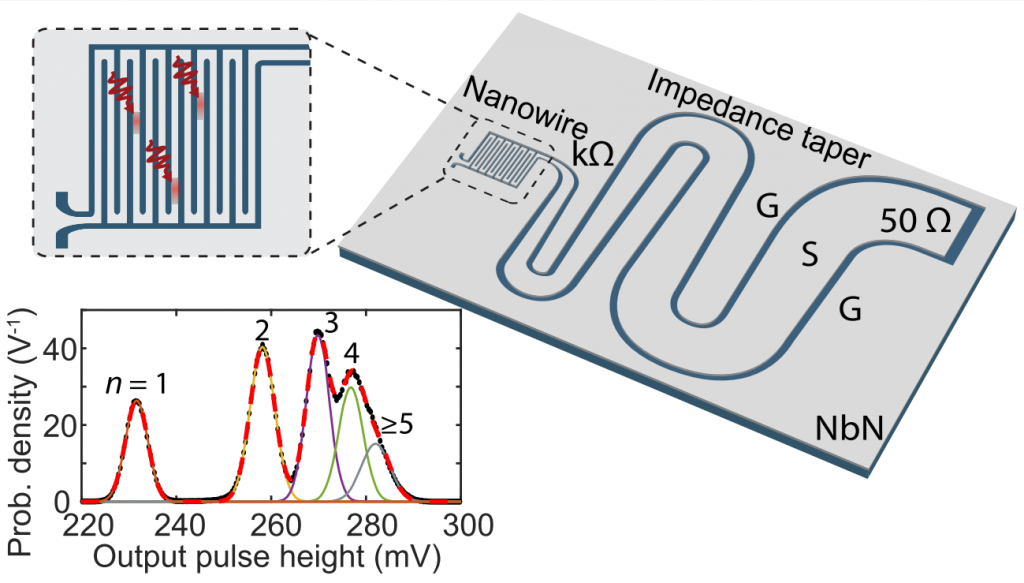
New Publication “Resolving photon numbers using a superconducting tapered nanowire detector”
Time- and number-resolved photon detection is crucial for quantum information processing. Existing photon-number-resolving (PNR) detectors usually suffer from limited timing and dark-count performance or require complex fabrication and operation. Here, we demonstrate a PNR detector at telecommunication wavelengths based on a single superconducting nanowire with an integrated impedance-matching taper. The taper provides a kΩ load impedance to the nanowire, making the detector’s output amplitude sensitive to the number of photon-induced hotspots. The prototyping device was able to resolve up to four absorbed photons with 16.1 ps timing jitter and <2 c.p.s. device dark count rate. Its exceptional distinction between single- and two-photon responses is ideal for high-fidelity coincidence counting and allowed us to directly observe bunching of photon pairs from a single output port of a Hong-Ou-Mandel interferometer. This detector architecture may provide a practical solution to applications that require high timing resolution and few-photon discrimination.
A complete description of the work may be found here.
New Publication “Demonstration of sub-3 ps temporal resolution with a superconducting nanowire single-photon detector”
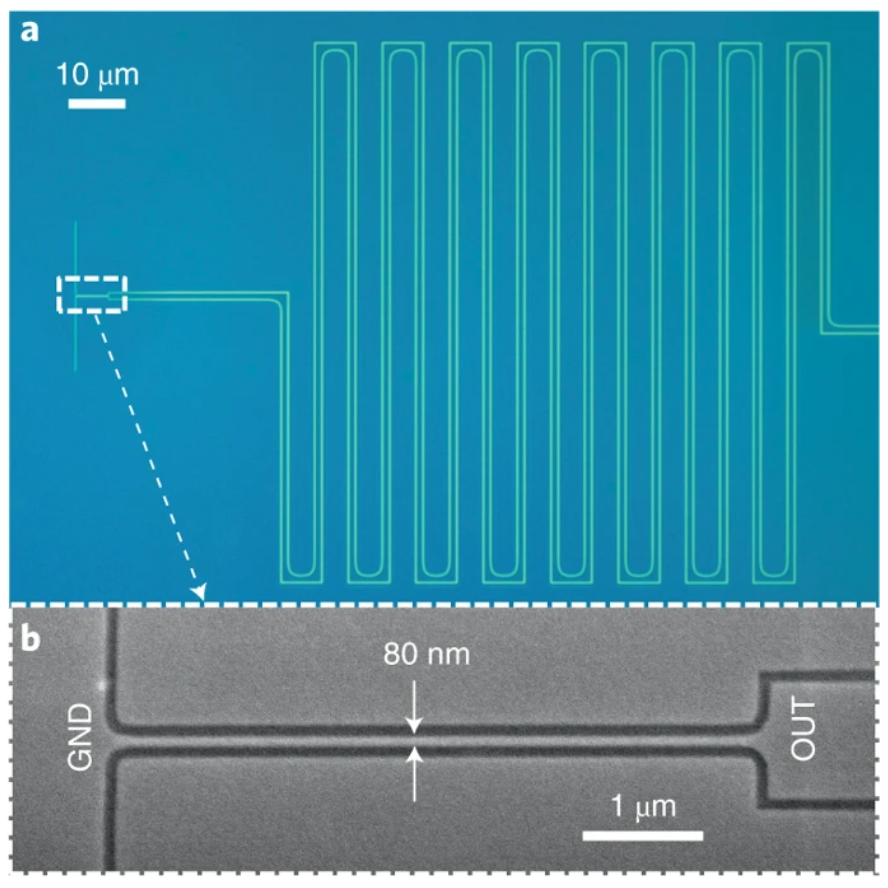
Improvements in temporal resolution of single-photon detectors enable increased data rates and transmission distances for both classical and quantum optical communication systems, higher spatial resolution in laser ranging, and observation of shorter-lived fluorophores in biomedical imaging. In recent years, superconducting nanowire single-photon detectors (SNSPDs) have emerged as the most efficient time-resolving single-photon-counting detectors available in the near-infrared, but understanding of the fundamental limits of timing resolution in these devices has been limited due to a lack of investigations into the timescales involved in the detection process. We introduce an experimental technique to probe the detection latency in SNSPDs and show that the key to achieving low timing jitter is the use of materials with low latency. By using a specialized niobium nitride SNSPD we demonstrate that the system temporal resolution can be as good as 2.6 ± 0.2 ps for visible wavelengths and 4.3 ± 0.2 ps at 1,550 nm.
A complete description of the work may be found here.
New Grant “Nanostructured optical-field samplers for visible to near-infrared time-domain spectroscopy”
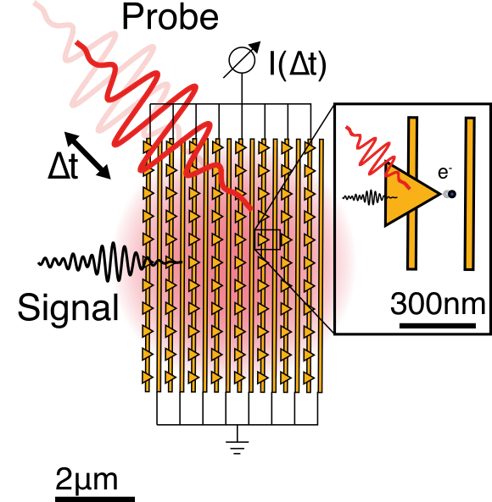
QNN awarded new SENSE.nano seed grant for the development of nanostructured optical-field samplers for visible to near-infrared time-domain spectroscopy.
More information on this project and the other SENSE.nano awards may be found here.
New Publication “Single-Photon Single-Flux Coupled Detectors”
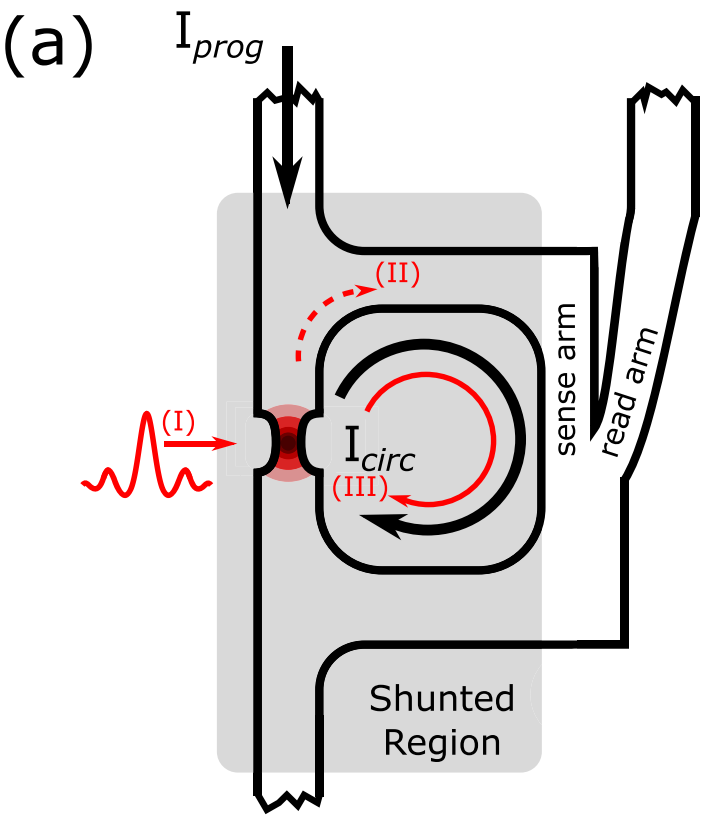
In this work, we present a novel device that is a combination of a superconducting nanowire single-photon detector and a superconducting multilevel memory. We show that these devices can be used to count the number of detections through single-photon to single-flux conversion. Electrical characterization of the memory properties demonstrates single-flux quantum (SFQ) separated states. Optical measurements using attenuated laser pulses with different mean photon number, pulse energies and repetition rates are shown to differentiate single-photon detection from other possible phenomena, such as multiphoton detection and thermal activation. Finally, different geometries and material stacks to improve device performance, as well as arraying methods, are discussed.
A complete description of the work may be found here.