News
Navid Abedzadeh awarded NSERC Fellowship
New publication: “Single-photon imager based on a superconducting nanowire delay line”
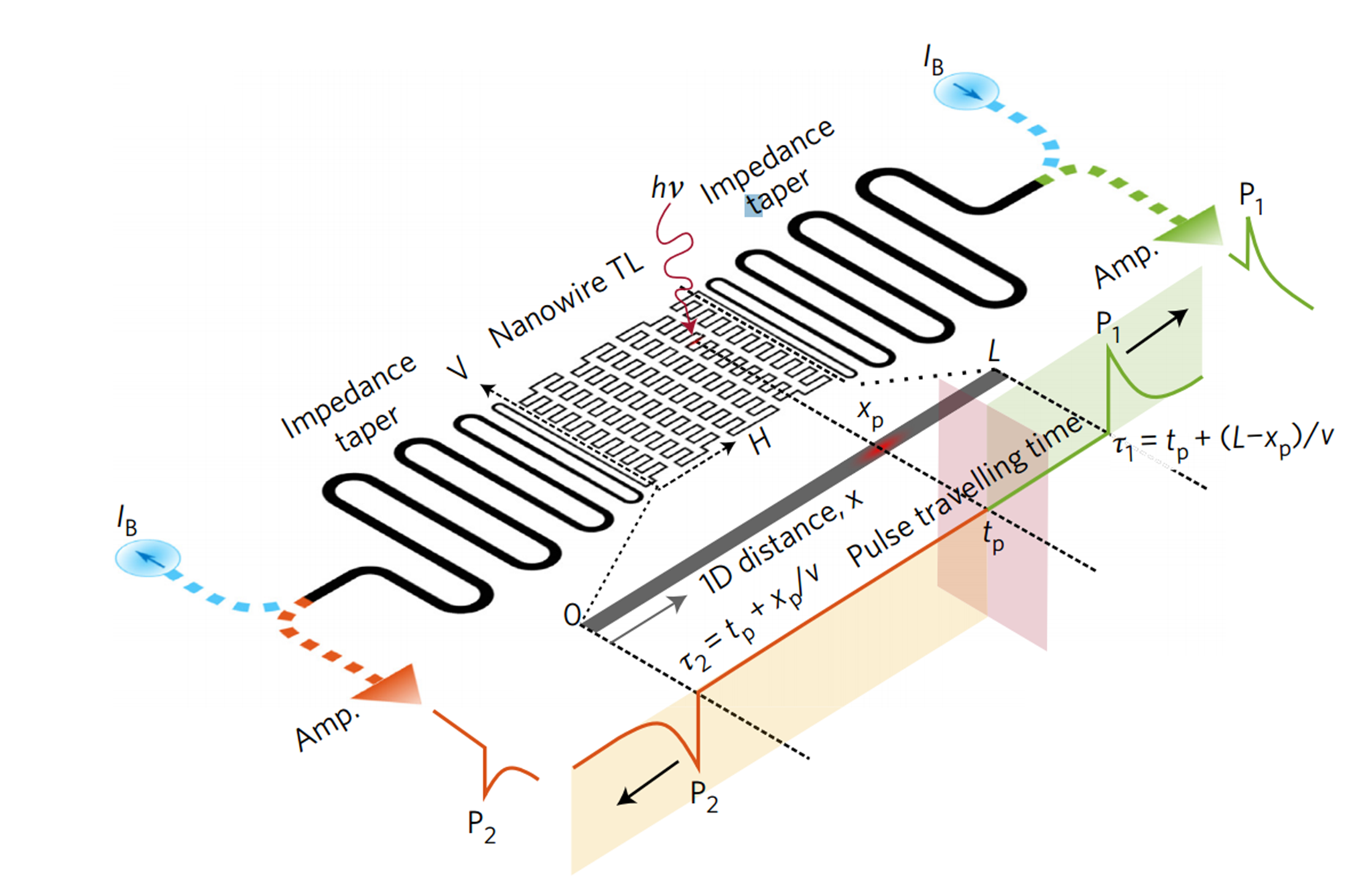
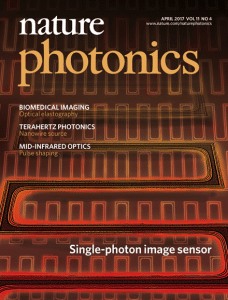 We demonstrate a scalable single-photon imager using a single continuous superconducting nanowire that is not only a single-photon detector but also functions as an efficient microwave delay line. In this context, photon-detection pulses are guided in the nanowire and enable the readout of the position and time of photon-absorption events from the arrival times of the detection pulses at the nanowire’s two ends. Experimentally, we slowed down the velocity of pulse propagation to ∼2% of the speed of light in free space. In a 19.7 mm long nanowire that meandered across an area of 286 × 193 μm2, we were able to resolve ∼590 effective pixels with a temporal resolution of 50 ps (full width at half maximum). The nanowire imager presents a scalable approach for high-resolution photon imaging in space and time. A full description of the publication may be found here.
Citation:
Qing-Yuan Zhao , Di Zhu, Niccolò Calandri, Andrew E. Dane , Adam N. McCaughan, Francesco Bellei, Hao-Zhu Wang, Daniel F. Santavicca, and Karl K. Berggren. “Single-photon imager based on a superconducting nanowire delay line,” Nature Photonics, vol. 11, p247-252, 2017.
New publication: “A nanocryotron comparator can connect single-flux-quantum circuits to conventional electronics”
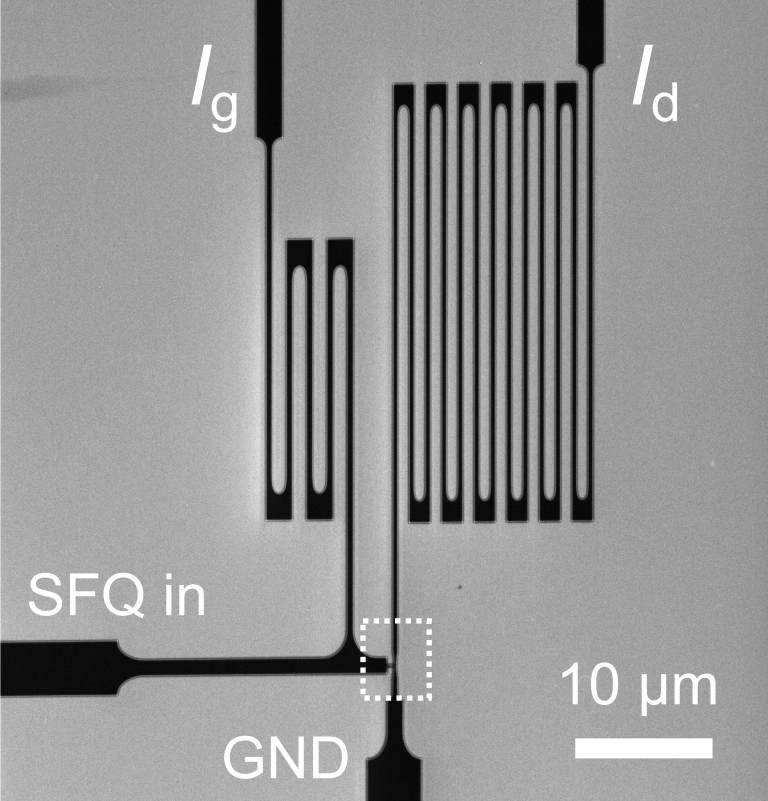
We demonstrate the use of a single three-terminal superconducting-nanowire device, called the nanocryotron (nTron), as a digital comparator to combine SFQ circuits with mature semiconductor circuits such as complementary metal oxide semiconductor (CMOS) circuits. Since SFQ circuits can digitize output signals from general superconducting devices and CMOS circuits can interface existing CMOS-compatible electronics, our results demonstrate the feasibility of a general architecture that uses an nTron as an interface to realize a ‘super-hybrid’ system consisting of superconducting detectors, superconducting quantum electronics, CMOS logic gates and memories, and other conventional electronics. A full description of the publication may be found here.
Citation:
Qing-Yuan Zhao, Adam N. McCaughan, Andrew E. Dane, Karl K. Berggren, Thomas Ortlepp.“A nanocryotron comparator can connect single-flux-quantum circuits to conventional electronics,” Supercond. Sci. Technol., vol. 30, no. 4, p. 044002, 2017.
New publication: “Photoemission from Plasmonic Nanoparticles”
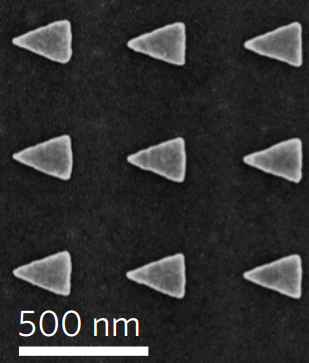
We demonstrate strong-field, carrier-envelope-phase-sensitive photoemission from arrays of tailored metallic nanoparticles, and we show the influence of the nanoparticle geometry and the plasmon resonance on the phase-sensitive response. Additionally, from a technological standpoint, we push strong-field light–matter interactions to the chip scale. A complete description of the publication may be found here.
Citation:
William P. Putnam, Richard G. Hobbs, Phillip D. Keathley, Karl K. Berggren, and Franz X. Kärtner. “Photoemission from plasmonic nanoparticles.” Nature Physics., Manuscript DOI: 10.1038/nphys3978. Available Online: December 19, 2016
New publication: “Using Geometry to Sense Current”
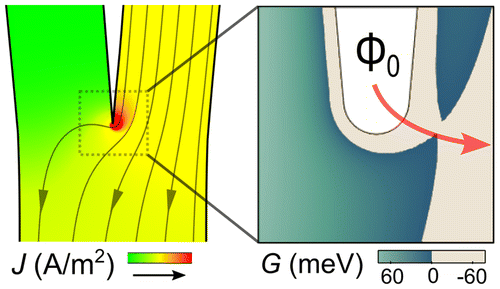
We describe a superconducting three-terminal Y-shaped device that uses a simple geometric effect known as current crowding to sense the flow of current and actuate a readout signal. A complete description of the publication may be found here.
Citation:
Adam N. McCaughan, Nathaniel S. Abebe, Qing-Yuan Zhao, and Karl J. Berggren. “Using geometry to sense current.” Nano Lett., Article ASAP., Manuscript DOI: 10.1021/acs.nanolett.6b03593. Available Online: November 29, 2016