News
New Publication “Jitter Characterization of a Dual-Readout SNSPD”
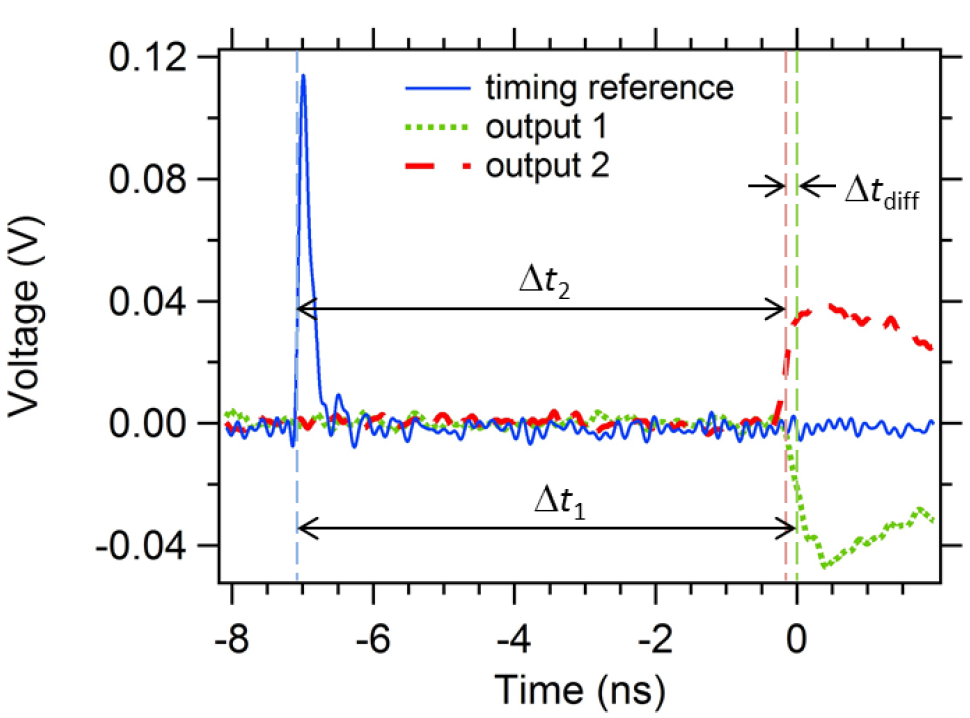
To better understand the origins of the timing resolution, also known as jitter, of superconducting nanowire single photon detectors (SNSPDs), we have performed timing characterizations of a niobium nitride SNSPD with a dual-ended readout. By simultaneously measuring both readout pulses along with an optical timing reference signal, we are able to quantify each independent contribution to the total measured jitter. In particular, we are able to determine values for the jitter due to the stochastic nature of hotspot formation and the jitter due to the variation of the photon detection location along the length of the nanowire. We compare the results of this analysis for measurements at temperatures of 1.5 K and 4.5 K.
A complete description of the work may be found here.
New Publication “Superconducting nanowire single-photon detector with integrated impedance-matching taper”
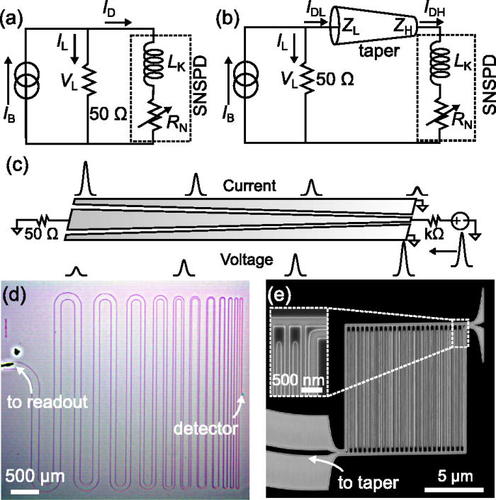
Conventional readout of a superconducting nanowire single-photon detector (SNSPD) sets an upper bound on the output voltage to be the product of the bias current and the load impedance, IB × Zload, where Zload is limited to 50 Ω in standard r.f. electronics. Here, we break this limit by interfacing the 50 Ω load and the SNSPD using an integrated superconducting transmission line taper. The taper is a transformer that effectively loads the SNSPD with high impedance without latching. At the expense of reduced maximum counting rate, it increases the amplitude of the detector output while preserving the fast rising edge. Using a taper with a starting width of 500 nm, we experimentally observed a 3.6× higher pulse amplitude, 3.7× faster slew rate, and 25.1 ps smaller timing jitter. The results match our numerical simulation, which incorporates both the hotspot dynamics in the SNSPD and the distributed nature in the transmission line taper. The taper studied here may become a useful tool to interface high-impedance superconducting nanowire devices to conventional low-impedance circuits.
A complete description of the work may be found here.
New Publication “Influence of tetramethylammonium hydroxide (TMAH) on niobium nitride thin films”
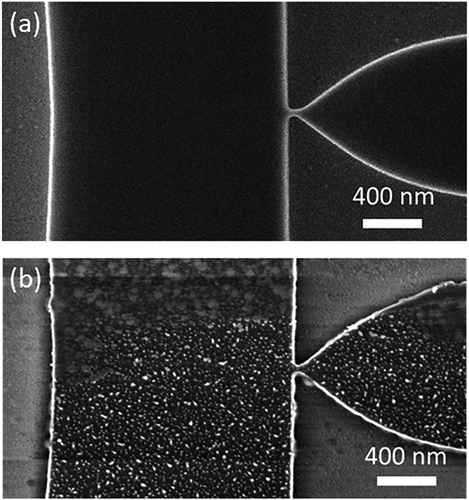
Functionality of superconducting thin-film devices such as superconducting nanowire single photon detectors stems from the geometric effects that take place at the nanoscale. The engineering of these technologies requires high-resolution patterning, often achieved with electron beam lithography. Common lithography processes using hydrogen silsesquioxane (HSQ) as the electron beam resist rely on tetramethylammonium hydroxide (TMAH) as both a developer and a resist adhesion promoter. Despite the strong role played by TMAH in the fabrication of superconducting devices, its potential influence on the superconducting films themselves has not yet been reported. In this work, the authors demonstrate that a 25% TMAH developer damages niobium nitride (NbN) thin films by modifying the surface chemistry and creating an etch contaminant that slows reactive ion etching in CF4. They also show how the identity of the contaminant may be revealed through characterization including measurement of the superconducting film properties and Fourier transform infrared spectroscopy. Although workarounds may be available, the results reveal that processes using 25% TMAH as an adhesion promoter are not preferred for NbN films and that changes to the typical HSQ fabrication procedure will need to be made in order to prevent damage of NbN nanoscale devices.
A complete description of the work may be found here.
New video “Studying Superconducting Thin Films”
Summer Program: Studying superconducting thin film
This summer, Lily Hallett investigated superconducting MoN thin films for use in nanowire single-photon detectors. She optimized deposition conditions for DC Magnetron Sputtering of MoN films and studied their superconducting and electrical properties. Low-pressure annealing experiments were performed in the sputtering chamber to increase the critical temperature of 5 nm films.
Studying Superconducting Thin Films
New Publication “Frequency Pulling and Mixing of Relaxation Oscillations in Superconducting Nanowires”
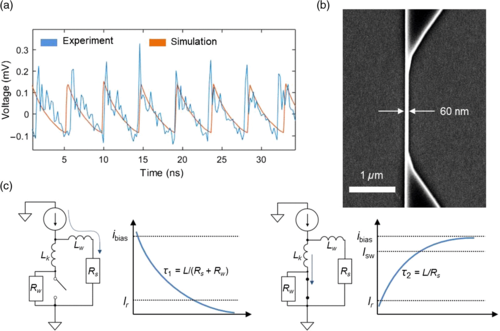
Many superconducting technologies such as rapid single-flux quantum computing and superconducting quantum-interference devices rely on the modulation of nonlinear dynamics in Josephson junctions for functionality. More recently, however, superconducting devices have been developed based on the switching and thermal heating of nanowires for use in fields such as single-photon detection and digital logic. In this paper, we use resistive shunting to control the nonlinear heating of a superconducting nanowire and compare the resulting dynamics to those observed in Josephson junctions. We show that interaction of the hotspot-impedance with an external shunt produces high-frequency relaxation oscillations with similar behavior to that observed in Josephson junctions due to their ability to be modulated by a weak periodic signal. In particular, we use a microwave drive to pull and mix the oscillation frequency, resulting in phase-locked features that resemble the Shapiro steps observed in the ac Josephson effect. Microwave nanowire devices based on these conclusions have promising applications in fields such as parametric amplification and frequency mixing.
A complete description of the work may be found here.
Citation:
Emily Toomey, Qing-Yuan Zhao, Adam N. McCaughan, Karl K. Berggren. “Frequency pulling and mixing of relaxation oscillations in superconducting nanowires” Physical Review Applied 9, 6 (2018)